
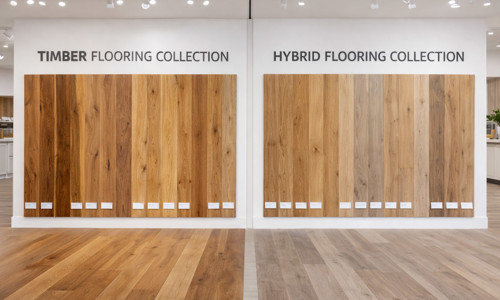


Online flooring advice often collapses into shortcuts. Timber gets reduced to a “natural” label. Hybrid gets reduced to a “tough” label. Neither shortcut helps once a floor is installed, because performance depends on how the product is built, how it is installed, and how it is used.
This guide keeps the comparison factual. It defines each type clearly, explains why the confusion exists, and shows what actually changes outcomes when choosing between wood floors and hybrid floors in Australian homes.
What “wood floors” mean in Australia
Wood floors are made of real timber. The main categories are solid timber and engineered timber.
Solid timber boards are a single piece of timber through the full thickness. Because the timber runs all the way through, the surface can be sanded and refinished multiple times over its life, depending on board thickness and condition.
Engineered timber has a real timber top layer bonded to a multi-layer core, often plywood or high-density fibreboard. The cross-grain structure is designed to reduce natural timber movement and improve stability compared with solid timber.
What “hybrid floors” mean in Australia
Hybrid flooring is a manufactured, multi-layer hard flooring system designed to look like timber using a printed decorative layer, rather than being timber through the board.
Most hybrid floors are built in layers. Common layers include a protective wear layer, a printed design layer, a rigid core, and often an attached acoustic underlay.
The rigid core is commonly one of these types:
SPC (stone plastic composite): limestone powder plus PVC and stabilisers, typically denser and harder.
WPC (wood plastic composite): wood plus PVC, typically thicker and softer underfoot, with different impact behaviour.
SWC (stone wood composite): described as a newer commercial-grade core using stone, resin, and high-density fibreboard.
Why do people get confused when comparing wood and hybrid
People get confused because “wood” is used as a loose label online, and because category names and ratings get treated like they automatically predict performance.
Wood flooring is timber, meaning the surface is real wood. In everyday online language, however, “wood flooring” is sometimes used to describe any hard floor that looks like timber, including hybrid and laminate. That is a naming shortcut, not a material description, and it leads to the wrong expectations.
The confusion also comes from marketing shorthand replacing construction details. A floor’s category name does not tell you how it behaves once installed, because performance depends on the layer stack, the core, the finish or wear layer, and the site conditions, including subfloor flatness, moisture management, and correct installation.
Another driver of confusion is mismatched ratings being compared as if they are interchangeable. Timber hardness is typically discussed using Janka, while hybrid wear layers are commonly discussed using AC (abrasion class). They measure different things and should not be compared directly.
The core difference: real timber movement vs engineered stability
Wood flooring moves with environmental moisture because timber is hygroscopic, meaning it absorbs and releases moisture. That movement is normal. It is also why timber installations require correct acclimatisation, expansion allowances, and appropriate installation methods, including floating installation or direct stick where suitable.
Engineered timber is designed to reduce that movement by using cross-grain layers. The referenced material describes the reduction in expansion and contraction tendency as up to 70% compared with solid timber, which is why engineered timber is often used where solid timber is more likely to have issues.
Hybrid floors do not behave like timber because the rigid core is a composite. In practical terms, hybrid tends to be more dimensionally stable as a material, but it still relies on correct subfloor preparation and correct installation to avoid joint stress and movement problems.
Moisture behaviour: what “water resistant” does and does not mean
Hybrid flooring is often described online as “waterproof”. A more accurate way to frame it is this: the hybrid plank material can be highly water resistant in the sense that the core does not swell like timber does, but the installed floor system is not a guaranteed waterproof barrier. Water can still move through joints and affect the subfloor or contribute to mould risk if moisture is not managed.
Wood flooring is moisture sensitive because timber is hygroscopic. Solid timber is more prone to visible movement and moisture-related distortion than engineered timber, because engineered construction improves stability, but neither should be treated as immune to water exposure.
What matters for decision-making is not the marketing label. It is your tolerance for moisture-related risk and your ability to control spills, cleaning practices, and subfloor moisture conditions.
Durability: separate “resists marks today” from “can be restored later”
Hybrid floors are commonly described as highly scratch-resistant because they use a protective wear layer. Timber’s day-to-day dent and scratch behaviour varies by species hardness and the finish system.
The more decision-relevant distinction is repairability.
Timber can often be sanded and refinished because the surface is real timber.
Hybrid floors cannot be sanded or refinished. If boards are damaged, the typical remedy is board replacement.
This is why it is risky to judge durability from the category name alone. You are comparing two different durability models. Hybrid tends to aim for higher day-to-day resistance at the surface. Timber tends to allow restoration over time, depending on wear layer thickness and overall condition.
Engineered timber wear layer thickness changes what “refinishable” really means
Engineered timber is not one uniform product type. The real timber top layer, often called the wear layer or lamella, can range from very thin to relatively thick. That thickness affects how many times the floor may be sanded and refinished.
The referenced material describes a typical range of 0.6 mm to 6 mm. It also notes that thicker wear layers can allow multiple refinishes, while thinner wear layers may allow one refinish or none.
If refinishing potential matters to you, compare wear layer thickness, not just “engineered timber” as a label.
Ratings and standards: how to compare apples with apples
Timber and hybrid ratings cannot be compared to each other because they measure different properties in different materials. Use the rating that matches the flooring type, then compare like with like.
Janka hardness (wood floors): Use Janka only to compare timber to timber. It measures the timber’s resistance to indentation, based on the force required to embed a steel ball into the wood. Higher numbers generally mean harder timber, but it is not a guarantee against marks.
AC rating, abrasion class (hybrid floors): Use AC rating only to compare hybrid to hybrid. It relates to the wear layer’s resistance to abrasion, and it also considers impact and stain performance. It does not measure timber hardness.
Installation reality: most failures are site-condition problems, not “bad flooring”
Both engineered timber floating floors and hybrid floating floors are sensitive to subfloor flatness. A common requirement referenced is a maximum deviation of 3 mm over 2 metres (sometimes cited differently depending on the product). Exceeding this can stress joints and contribute to squeaks or joint failure.
Moisture testing also matters. The referenced material notes concrete slabs should be tested and gives indicative thresholds, including an in-slab relative humidity figure, to reduce moisture-related risk.
For hybrid floors specifically, the material highlights a common misconception: assuming the plank’s water resistance means moisture management is optional. It describes joint failure mechanisms linked to moisture and slab conditions, and notes that missing underlay moisture protection can contribute to failures.
If you are choosing between wood and hybrid, you should also be choosing an installation approach that matches the site. Subfloor testing and preparation are part of the flooring decision, not an optional add-on.
Maintenance: “low effort” is not the same as “no care required”
Hybrid floors are often described as easier to clean because they can tolerate damp cleaning better than timber in normal day-to-day use, but “easy” does not mean immune to damage. The referenced material explicitly warns against absolute claims like “scratch-proof” and makes clear that no flooring is scratch-proof.
Timber typically requires more controlled cleaning practices because excessive moisture can affect boards and finishes over time. The practical decision point is your willingness and ability to follow the care requirements consistently, including using appropriate cleaning methods and protecting high-wear points.
Common misconceptions, corrected
Hybrid flooring is waterproof.
Hybrid planks can be highly water-resistant because the core does not swell like timber, but that does not mean the installed floor system is a waterproof barrier. Water can still move through joints and affect the subfloor.
Hybrid flooring has replaced timber.
They are different systems designed around different trade-offs. Timber offers a real wood surface and potential restoration pathways, while hybrid offers a manufactured wear surface and different moisture behaviour, with different repair options.
Wood floors are unsuitable for modern homes.
Wood floors are used successfully when the product type and installation method match the site conditions. Engineered timber exists specifically to improve stability compared with solid timber, and wear layer choices affect long-term maintenance options.
Hard flooring performance can be judged by name alone
.
Category labels are too broad. You need to compare construction (layers and core), rating system relevance (Janka vs AC), and installation requirements (flatness and moisture conditions) to predict outcomes.
Decision factors that actually change the outcome
If you want a decision that holds up after installation, compare these factors directly.
Real timber surface vs printed design layer
Timber is real wood at the surface. Hybrid uses a printed decorative layer under a wear layer. This affects how the floor looks up close, how it changes over time, and what “repair” can realistically mean.
Repair pathway
Timber may be refinished. Hybrid is not refinishable and typically relies on board replacement for damage.
Moisture risk tolerance
Hybrid planks can be highly water-resistant, but the system is not a guaranteed water barrier. Timber is moisture sensitive because it is hygroscopic.
Site conditions and installation discipline
Both floating systems are sensitive to subfloor flatness and moisture conditions. If the subfloor is not within tolerance, the floor can fail regardless of category.
Correct rating interpretation
Use Janka for timber hardness and AC rating for synthetic wear layers. Do not cross-compare them as if they measure the same property.
Optional next step for a neutral shortlist
A reliable comparison usually needs one extra step beyond online research: confirm your subfloor condition and moisture risk before you lock in a category. The same flooring can perform well or poorly depending on whether the site is prepared to the required flatness and moisture standards.
Explore our wood flooring range and our hybrid flooring range to see the construction options available, including engineered timber wear layer differences and hybrid core types.
Before you decide, use the RoomView visualiser to see how different wood and hybrid looks may appear in your own space. RoomView is designed to help you compare colours and finishes in context, so you are not relying on showroom lighting alone.
If you would like a professional recommendation based on your home, book a free measure and quote. A flooring specialist can come to your home, check key site conditions, and talk you through the practical trade-offs between wood and hybrid based on your installation and care requirements.


